
October 27, 2026
PG Viewing Checklist: What to Inspect Before You Choose a Room
Use this PG viewing checklist to inspect the actual room, ask about services and record unresolved questions before deciding where to stay.
A PG viewing should answer two different questions: what can you observe yourself, and what is the operator promising to provide? Keep those answers separate. A clean room on the day of a visit does not establish how consistently water, meals, cleaning or access will work after you move in.
Visit the actual room offered to you, with its proposed occupancy and bed allocation. If you are shown a sample room, record that limitation and ask to see the assigned room before committing.
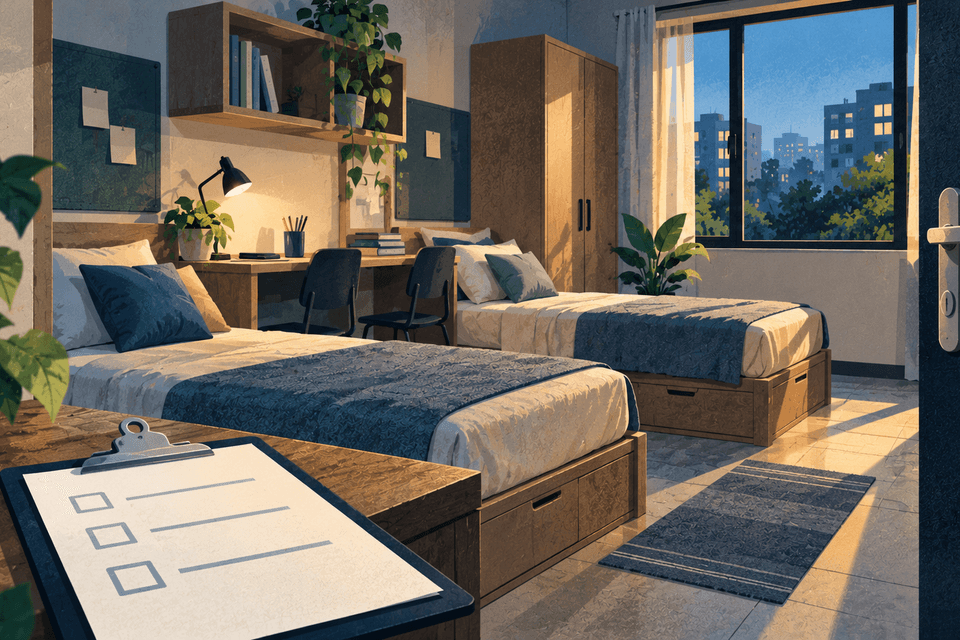
Look at the room as an occupied space
Check how much usable space remains when every bed is occupied. Look for storage, accessible sockets, a place to work if needed, and a route to the door that does not require moving furniture. Ask which cupboards and fixtures belong to your bed allocation.
Open the windows where permitted and look at ventilation, daylight and signs of damp. Record what you see rather than treating a fresh coat of paint or a pleasant smell as evidence that a recurring issue has been resolved. Ask who receives maintenance requests and how an unresolved request is escalated.
If you expect to work night shifts, study early or take calls from the room, explain that routine. A room can be physically suitable while its shared routine is a poor fit.
Use three columns during the viewing
The table below is a note-taking framework, not a building inspection or safety certification. A blank answer means you still need information.
| Area | What to observe | What to ask and confirm |
|---|---|---|
| Occupancy and storage | Actual beds, cupboard space and movement around furniture | Maximum occupancy of your room; whether bed or room allocation can change |
| Bathroom and water | Cleanliness, visible leaks and, with permission, working taps | Number of users, cleaning responsibility and arrangements during water interruptions |
| Meals | The dining area and a meal service if the visit coincides with one | Included meals, timings, days off, dietary options and charges for extras |
| Ventilation and utilities | Windows, visible damp, sockets and installed appliances | Electricity billing, appliance restrictions and what backup power actually supplies |
| Access and exits | Your normal entrance, exit routes and any visible obstructions | Late-arrival procedure, visitor rules and whom to contact in an emergency |
| Support | Displayed contact details and the stated reporting process | Who resolves complaints, how to record a request and what happens if it remains open |
For each row, add three short notes: observed, operator's answer, and unresolved. “There is a backup generator” is an answer; “the room fan worked during a demonstrated power changeover” is an observation. Neither alone establishes continuous service.
Do not test electrical equipment, fire systems or access controls yourself. Ask the operator for relevant information and demonstrations they can safely provide. Serious concerns about exits, wiring or other conditions warrant a qualified assessment, not reassurance from a checklist.
Check the service at the time you will use it
If possible, arrange a permitted visit around a meal or your expected return time. A daytime tour may not answer whether dinner is available after your shift or how a late arrival is handled.
With their consent, ask current residents specific questions: how they report a water problem, what a recent electricity bill included, or whether the published meal timings match their experience. Treat those answers as individual accounts. Do not photograph residents, their belongings or their documents without permission.
Put the operating terms beside the room notes
Request a written breakdown of rent, deposit, maintenance, electricity, meals, laundry and other charges. Ask about the billing unit: per person, bed, room or meter. Clarify which services are optional and how charges can change.
Record notice and exit terms, the deposit settlement process, house rules, room-change terms and the operator's contact details. Check whether a promised arrangement is in the terms you will actually accept. If a material answer remains unresolved, treat that as a decision still to make rather than filling the gap with an assumption.
Confirm the operator's authority and payment recipient before paying. A viewing is one part of verification, not proof that every subsequent request is legitimate.
Make the final comparison on your routine
Give each shortlisted PG a short verdict: what works for your daily routine, which commitments are confirmed, and which questions remain open. Choose based on the actual room and documented arrangement, not only the photographs or the number of amenities advertised.
At move-in, keep a condition record of your allocated space and supplied items. RentAid's move-in and move-out proof guide explains its recording workflow. A condition record helps preserve what was observed; it does not certify the premises or replace the terms of your stay.